Shape bugs, caught before anything runs
numty is a mypy plugin that knows the shape of every NumPy array in your
code. A transposed matrix or a missing keepdims becomes a type
error on the line that caused it.
Get started Browse the bug gallery
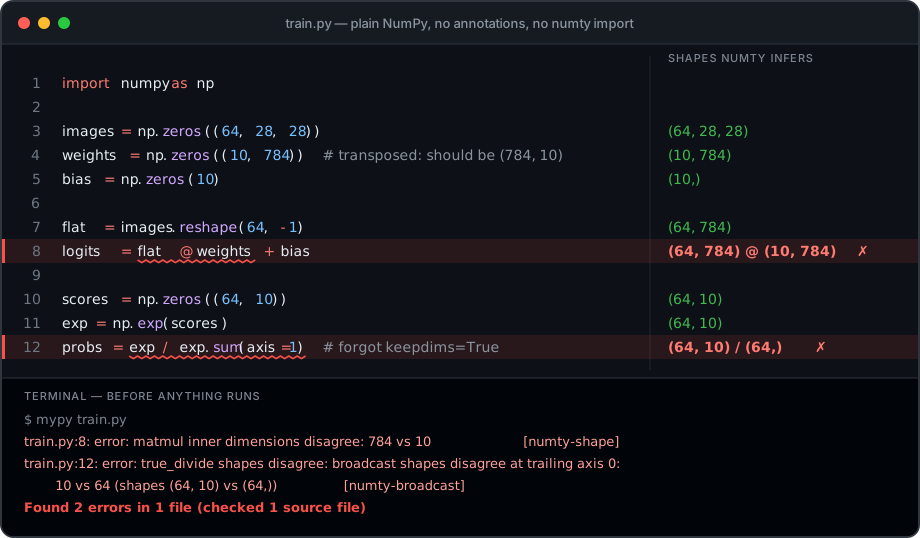
Plain NumPy, no annotations
The file above imports nothing from numty and annotates nothing. Here it is as text:
import numpy as np

images = np.zeros((64, 28, 28))
weights = np.zeros((10, 784))  # transposed: should be (784, 10)
bias = np.zeros(10)

flat = images.reshape(64, -1)
logits = flat @ weights + bias

scores = np.zeros((64, 10))
exp = np.exp(scores)
probs = exp / exp.sum(axis=1)  # forgot keepdims=True
train.py:8: error: matmul inner dimensions disagree: 784 vs 10  [numty-shape]
train.py:12: error: true_divide shapes disagree: broadcast shapes disagree at trailing axis 0: 10 vs 64 (shapes (64, 10) vs (64,))  [numty-broadcast]
mypy reports both without executing a line. numty worked out that
reshape(64, -1) of (64, 28, 28) is (64, 784), carried that into the
@, and saw that sum(axis=1) drops an axis the division needs.
The second bug is the dangerous kind
With 10 samples instead of 64, NumPy would broadcast (10, 10) / (10,)
without complaint and return probabilities normalised along the wrong
axis. No exception, no warning, wrong numbers.
Name the sizes once and it does the algebra
One signature, no annotations in the body. Every comment is the shape numty infers, as a formula over the names in the signature:
import numpy as np
from numpy.lib.stride_tricks import sliding_window_view
from numty import F64, I64

def features(
    signal: F64["batch time"],
    image: F64["batch chan height width"],
    offsets: I64["batch+1"],
) -> None:
    np.diff(signal, axis=1)                     # (batch, time-1)
    np.fft.rfft(signal, axis=1)                 # (batch, time//2+1), complex128
    sliding_window_view(signal, 5, axis=1)      # (batch, time-4, 5)
    np.pad(signal, ((0, 0), (2, 2)))            # (batch, time+4)
    np.concatenate([signal, signal], axis=1)    # (batch, 2*time)
    image.reshape(image.shape[0], -1)           # (batch, chan*height*width)
    np.diff(offsets)                            # (batch,)
    signal[:, 1:] - signal[:, :-1]              # (batch, time-1)
    signal[:, 1:] - signal                      # off by one
error: broadcast shapes disagree at trailing axis 0: time-1 vs time (shapes (batch, time-1) vs (batch, time)) [numty-broadcast]
batch, time, chan, height and width are never declared: the
strings mint them. The sizes are unknown until the function is called,
and the off-by-one on the last line is still an error, because time-1
cannot equal time whatever time is.
A whole attention block from one signature
import numpy as np
from numty import F32

def attention(
    q: F32["batch heads seq dim"],
    k: F32["batch heads seq dim"],
    v: F32["batch heads seq dim"],
) -> F32["batch heads seq dim"]:
    scores = q @ k.swapaxes(-1, -2)            # (batch, heads, seq, seq)
    scores = scores - scores.max(axis=-1, keepdims=True)
    weights = np.exp(scores)
    weights = weights / weights.sum(axis=-1, keepdims=True)
    return weights @ v
Four symbolic dims through a batched matmul, a transpose, two keepdims
reductions and two broadcasts, with the return checked against the
signature. Drop the @ v and return the weights by mistake, and the two
shapes are named side by side:
error: Incompatible return value type (got "ndarray[tuple[batch, heads, seq, seq], dtype[floating[_32Bit]]]", expected "ndarray[tuple[batch, heads, seq, dim], dtype[floating[_32Bit]]]") [return-value]
Why trust it
-
Checked against NumPy itself
A differential test generates NumPy expressions and compares numty's answer with what NumPy returns. The latest long run covered 42,000 expressions with no disagreements.
-
It finds seeded bugs
The benchmark hides 18 realistic mistakes in MLP-training and math-library code. 17 are reported before anything runs.
-
It runs on real library code
scikit-learn's Cholesky ridge solver is annotated, checks clean, and agrees with scikit-learn's own results in the test suite.
-
Unknown is not an error
When a size cannot be known statically numty says nothing and keeps checking the dims around it, so unannotated code stays quiet.
Every example on this page is a file in tests/fixtures and is pinned by the test suite, message for message.
Where next
-
Install, add two lines to
mypy.ini, run mypy. -
Annotating shapes, named sizes, symbolic arithmetic, unknown dims, indexing.
-
The same look, checked statically. A converter rewrites existing files.
-
Every supported operation, the ten error codes, tracing and strict mode.